Keep the phases separate
Index preparation happens before a question arrives. Chunk IDs connect retrieval stores to the original text and source locator.
INSIDE THE FIGUREFOUNDRY RAG DIAGRAM KIT
Compare three RAG architectures and the layouts built around them. Follow a source into an answer, then adapt the editable files to your own method.
BROWSE THE ACTUAL DIAGRAMS
Pick the method first, then the available layout.
The previews show the included compositions.
Dense and BM25 retrieval → rank fusion → cross-encoder reranking → cited answer.
This architecture includes all three layouts.
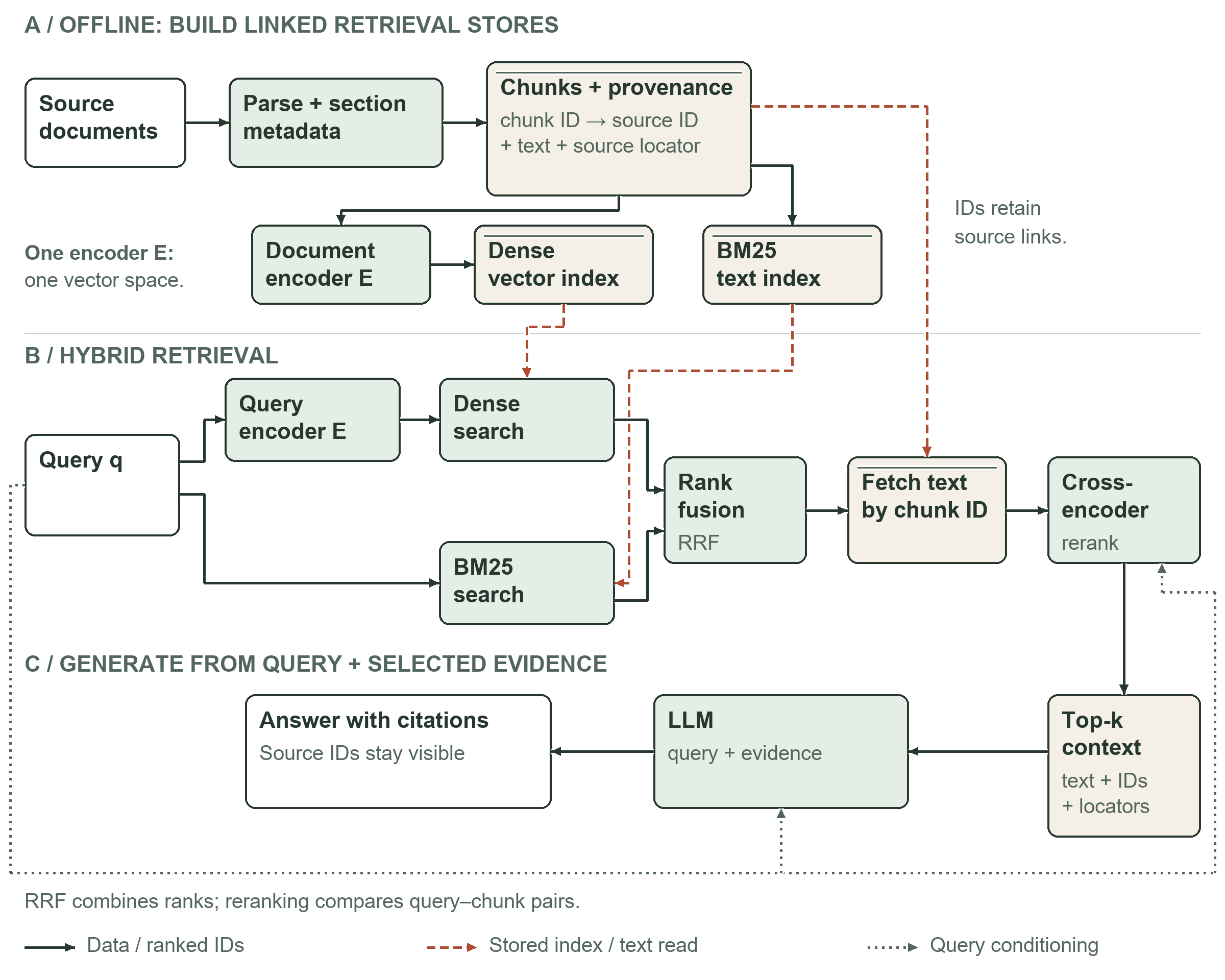
The complete method across a two-column span, with parallel retrieval branches, rank fusion, reranking and explicit query-conditioning paths.
Illustrative hybrid RAG with reranking. Offline indexing preserves chunk text and source identifiers for lexical and dense retrieval. Reciprocal rank fusion combines candidate rankings; a query-aware cross-encoder reranks the candidates before context assembly. The original question, evidence text and source labels feed the answer. Citations provide traceability, not a guarantee of correctness.
RAG: retrieval-augmented generation. RRF: reciprocal rank fusion. BM25: a lexical retrieval scoring method. These are illustrative architecture choices, not a claim that one performs better on your data.
Index preparation happens before a question arrives. Chunk IDs connect retrieval stores to the original text and source locator.
The question feeds retrieval and generation, and the reranker where that stage is present. Hybrid variants fuse ranks, not incompatible raw scores.
Context contains text and source locators. Source IDs alone are not evidence, and a citation needs to point to a supporting passage.
ONE INCLUDED WORKED EXAMPLE
Select each source to inspect its text and locator. The example separates relevant evidence from a plausible distractor.
ORIGINAL QUESTION
ILLUSTRATIVE ANSWER
Build logs are retained for 14 days .
S1 supports the claim about build logs. Its source locator stays attached to the retrieved chunk.
“Build logs are retained for 14 days.”
Supports the answer. The subject and retention period match the question.
Fictional demonstration content. These are invented handbook passages, not actual retention policies or measured retrieval results. No model runs on this page.
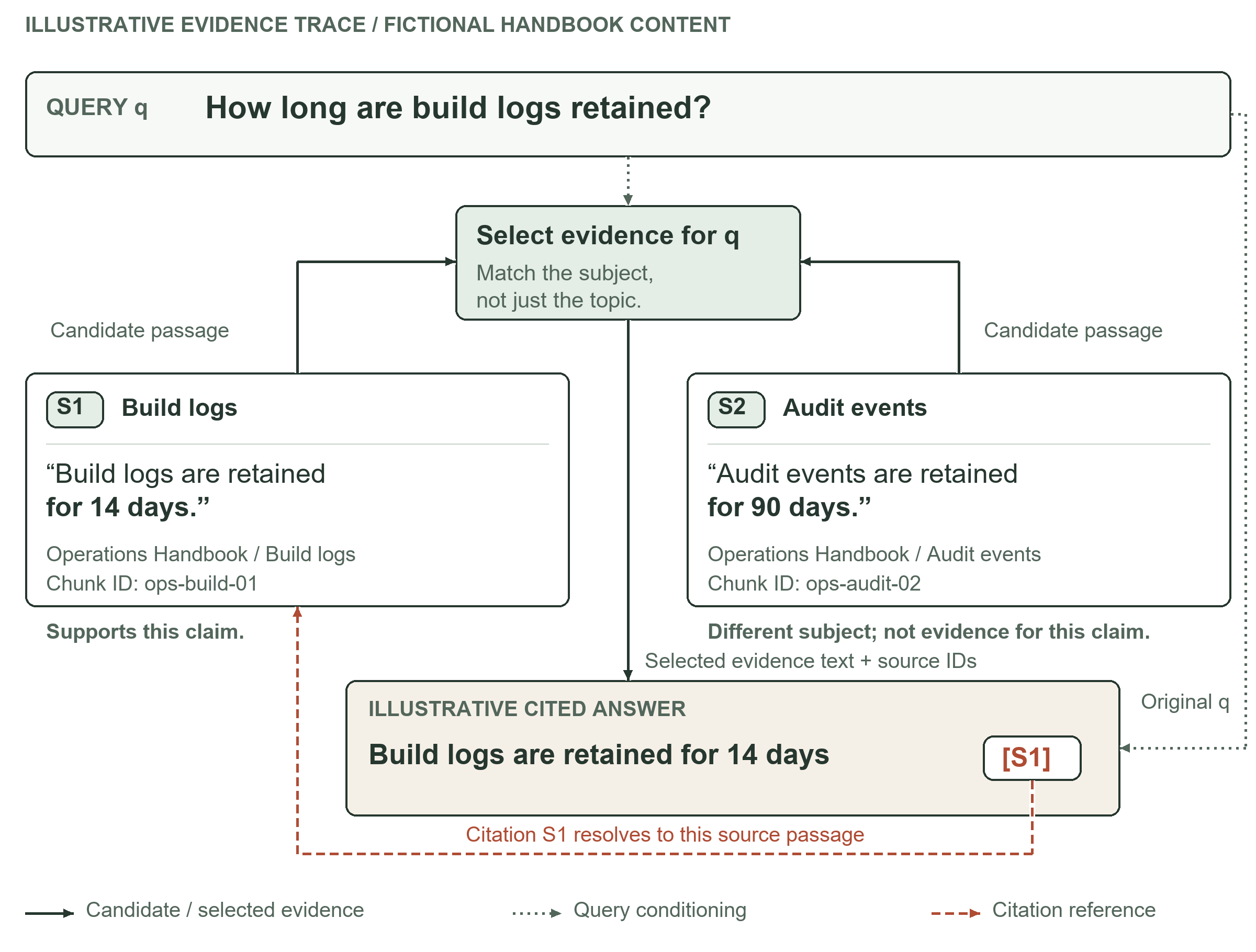
The editable draw.io file, SVG and PNG are included in the paid kit.
THE VARIANT MATRIX
Three architectures. Seven layout files.
Each layout includes draw.io, SVG and PNG.
| Architecture | 85 mm single column | 170 mm double column | 16:9 presentation | Layouts |
|---|---|---|---|---|
| Hybrid + rerank | Included | Included | Included | 3 |
| Dense + rerank | — | Included | Included | 2 |
| Hybrid without rerank | — | Included | Included | 2 |
| Total layout compositions | 7 | |||
The single-column hybrid figure is tall: 85 × 213.9 mm at its intended size. Reserve sufficient column height. No single-column version is claimed for the other two architectures.
THE USEFUL PART IS WHAT YOU CAN CHANGE
Keep a consistent visual language as you change the diagram. Native editable objects and an editing guide help you adapt modules and review their relationships.
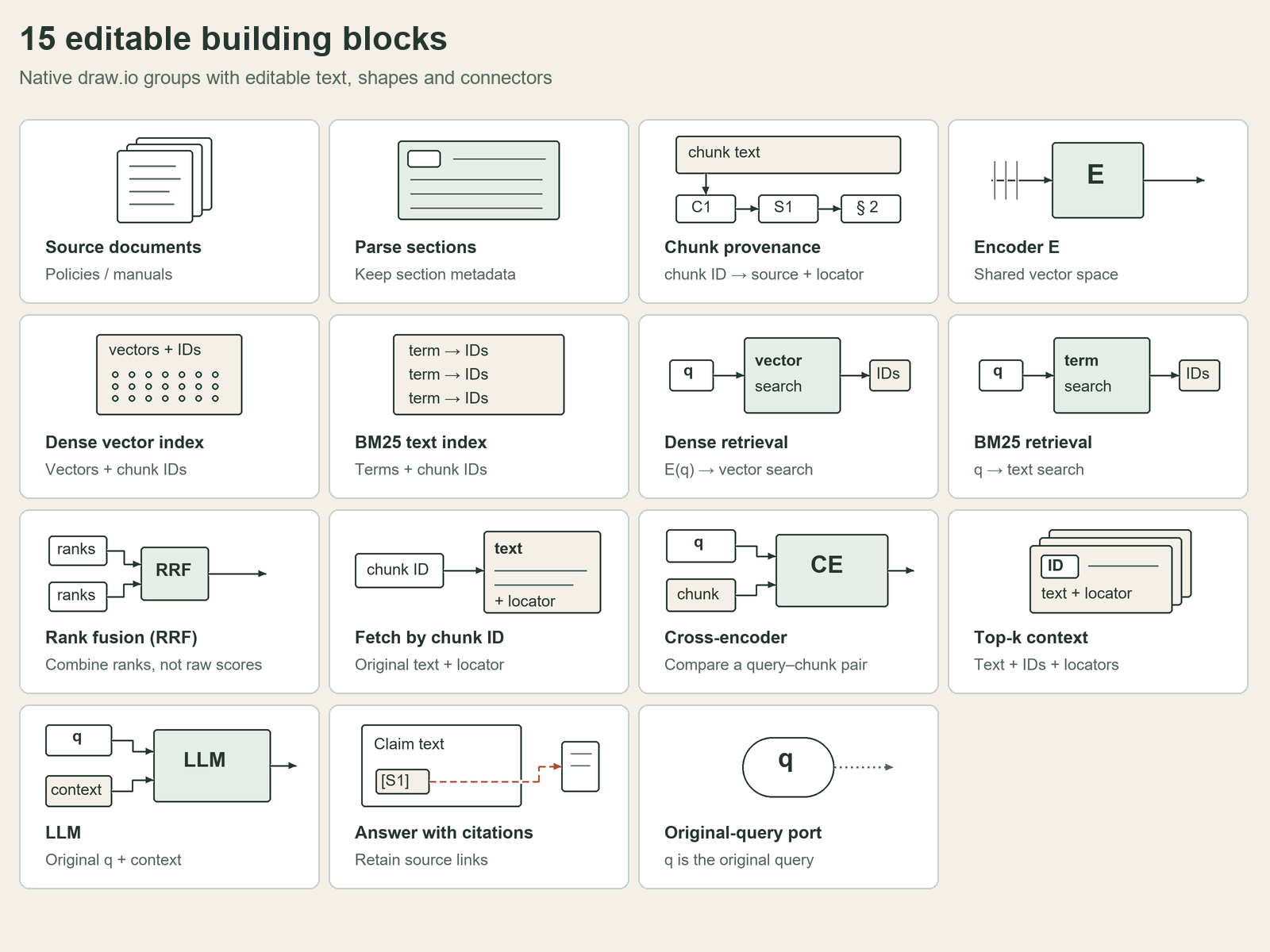
This is an editable diagram kit with seven layouts across three architectures and a set of visual components. It does not run a RAG service, include model weights or promise retrieval accuracy. It includes hybrid retrieval with reranking, dense retrieval with reranking and hybrid retrieval without reranking. Adapt the architecture that reflects your actual system.
Yes. Adapt the source diagram to the system you actually built. If you remove a stage, reconnect its inputs and outputs, update the query paths and revise the caption. The included editing guide explains the relationships to check.
The hybrid 85 mm and 170 mm variants are different compositions. The other two architectures provide 170 mm and 16:9 versions. Use the intended width when exporting and check readability in your final document. Your publisher’s figure requirements still apply.
The kit follows documented patterns for chunk-to-source mapping, hybrid retrieval and reranking, and grounded prompts and references. The artwork is independently created; these links do not imply endorsement.